
Asserting repeatedly that the second wave of the pandemic is not over, the government said that though the situation is plateauing, the country is still reporting as high as 20,000-odd new infections every day.
A total 179 deaths deaths have been reported since Monday evening, of which 98 were from West Bengal, 35 from Maharashtra, 29 from Gujarat, six from Rajasthan, five from Uttar Pradesh, two from Punjab and one each from Chandigarh, Haryana, Karnataka and Tamil Nadu.

In a press briefing, officials said the virus outbreak is under control in the country and credited a robust surveillance network along with implementation of the lockdown and other containment measures for it.
Addressing a daily media briefing to give updates on the COVID-19 situation in the country, Joint Secretary in the Health Ministry Lav Agarwal said most of the Markaz event-related cases have been found in states with high burden of the disease, such as Tamil Nadu (84 per cent), Telengana (79 per cent), Delhi (63 per cent), Uttar Pradesh (59 per cent) and Andhra Pradesh (61 per cent).

Eleven states -- Maharashtra, Karnataka, Uttar Pradesh, Kerala, Rajasthan, Gujarat, Chhattisgarh, Andhra Pradesh, Tamil Nadu, West Bengal and Bihar -- cumulatively account for 78.18 per cent of the active cases in the country, according to the health ministry.

Nearly half of all coronavirus patients in the country have been cured, taking the recovery rate to over 48 per cent.

The Reproduction number or Rt refers to how many people an infected person infects on average. In other words, it can tell how efficiently a virus is spreading.
However, two districts -- Pilibhit in Uttar Pradesh and Shaheed Bhagat Singh Nagar in Punjab -- which did not record a fresh case in the last 28 days, reported new COVID-19 cases on Monday, it added.
Agarwal said that the current 'R0' or R naught for the coronavirus infection is somewhere between 1.5 and 4.
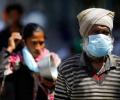
Talking about the Tablighi Jamaat congregation, Agarwal said, "If the Tablighi Jamaat incident had not taken place and we compare the rate of doubling -- that is in how many days the cases have doubled, we will see that currently it is 4.1 days (including Jamaat cases) and if the incident had not taken place and additional cases had not come then the doubling rate would have been 7.4 days."
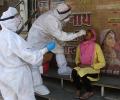
"Lockdown and containment (measures) have been successful in keeping it low and preventing rapid spread," ICMR Director General Balram Bhargava said, citing the sero-survey on COVID-19 spread.
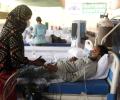
The Union health ministry said 11 states have over one lakh active COVID-19 cases, 17 have less than 50,000 cases while eight have active cases between 50,000 and one lakh.

'Scientifically the effect and change of Delta plus has to be watched through our INSACOG system. This has to be detected and we have to see its presence in the country'

'We have to ensure the European situation does not occur in India and we don't see a spread like theirs.'

Six hundred and thirty COVID-19 patients have recovered in the last 24 hours, taking the recovery rate to 25.19 per cent in the country, said Lav Agarwal, joint secretary, ministry of health and family welfare, on Thursday.

The govt said that states have been asked to classify districts which have reported a higher number of cases as hotspots, the districts where cases have been reported as non-hotspots, and green zones where no cases have been reported.

During the daily media briefing, Lav Agarwal, Joint Secretary, Union Health and Family Welfare Ministry, said that 16 districts in the country, which earlier had cases, have not reported any fresh cases for the last 28 days.

With these states imposing lockdowns anew, the health ministry emphasised that the restrictions should be utilised to focus on containment, surveillance and testing in the containment and buffer zones as the key strategy for early detection of cases and fatality management.

Also, the recovery rate in COVID-19 patients has progressively improved from 13.06 per cent to over 25 per cent in the country over the last 14 days. Addressing a press briefing, Joint Secretary in the ministry Lav Agarwal said the doubling rate of COVID-19 cases in several states is better than the national average.
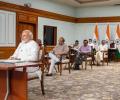
Nivedita Mookerji goes in search of the elusive war room to track and respond to the coronavirus threat.

The experts agreed that the lockdown has helped in slowing down spread of the virus but insisted that the situation has not reached a plateau and that there was an urgent need to upgrade healthcare facilities to deal with the crisis.

Addressing a press briefing, health ministry Joint Secretary Lav Agarwal said currently there are no approved therapies for COVID-19 and there is not enough evidence to claim that plasma therapy can be used for treatment of the disease.
Joint Secretary in the Ministry of Health Lav Agarwal said that India has a stock of 3.28 crore tablets of hydroxychloroquine, which is three time more than the projected requirement of one crore tablets in the country for the coming week and that tie-ups have been made for additional supply of 2 to 3 crore tablets for the future need.
The ICMR's statement came against the backdrop of the World Health Organization (WHO) suspending the testing of the drug in COVID-19 patients temporarily in its global study following safety concerns.
This was the sixth consecutive day when coronavirus cases increased by more than 14,000. Consequently, India has added 92,573 cases since June 20, and over 2.82 lakh this month alone since June 1.
Out of the 12 deaths reported in the last 24 hours some are related to the Tablighi Jamaat congregation, Joint Secretary in the Health Ministry Lav Agarwal said in a daily media briefing.
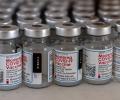
Currently, the country is using two 'made-in India' jabs -- Covishield and Covaxin -- to inoculate its billion-plus population and has administered 20 crore doses since launching the world's largest vaccination drive in mid-January. A third vaccine, Russian-made Sputnik V, has been approved by the government and is being used on a smaller scale at present.

Two cases of the new Omicron variant of coronavirus have been detected in Karnataka, the Union government said on Thursday while asking people not to panic but follow Covid-appropriate behaviour and get vaccinated without delay.

The Centre said the upsurge of COVID-19 cases is happening in cities and the Omicron variant is the predominant circulating strain.
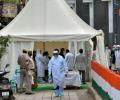
The markaz (centre) in the south Delhi neighbourhood organised a Tabligh-e-Jamaat from March 1-15 and at least 2,000 people, including foreigners and Indians from across the country, attended it.

Addressing the daily press briefing on the actions taken, preparedness and updates on COVID-19, Joint Secretary in the Ministry of Health Lav Agarwal said 92 new cases and four deaths due to coronavirus have been reported in India since Sunday, taking total cases to 1,071 and the number of deaths to 29.

As per the ministry's updated data on coronavirus cases Saturday morning, six fresh deaths were reported -- three from Maharahtra, two from Delhi and one from Gujarat.
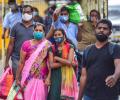
Addressing a press conference, NITI Aayog Member (Health) Dr V K Paul said the question of the third wave keeps coming up because the population is still 'very vulnerable' to the infection.

The death toll climbed to 15,301 with 407 new fatalities, according to the Union health ministry data.

'We have the technical expertise, and international collaborations. We also have robust real-time data. We are a university of pandemic management. If the ministry neglects the role of NCDC, it is the loss of the country'

The highest number of confirmed cases are from Maharashtra (748), followed by Tamil Nadu at 571 and Delhi with 523 cases. Cases in Telangana have gone up to 321, in Kerala to 314, in Uttar Pradesh to 305, while the number of cases has gone up to 274 in Rajasthan.
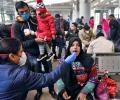
According to the latest data available from the Centre and the states in the night, the total number of Omicron cases in the country was around 1,200.

The Indian Council of Medical Research will start national-level sero surveys to assess the spread of Covid-19 and all states/Union territories should also be encouraged to conduct them so that information from all geographies can be collected, the Union health ministry said on Friday.
The lockdown in India has been a timely, graded, proactive and pre-emptive public health measure to fight the COVID-19 pandemic and has been part and parcel of the government's overall strategy, Dr V K Paul, Member (Health), NITI Aayog, and Chairman, Empowered Group 1, said at a media briefing on the COVID-19 situation.

The official said in general, there are various types of fungal infections such as candida, aspergillosis, cryptococcus, histoplasmosis and coccidioidomycosis. Mucormycosis, candida and aspergillosis are the ones observed more in those with low immunity, he said.
 © 2026 Rediff.com - Advertise with us - Disclaimer - Privacy Policy - Sitemap - Feedback - About us - Terms of use - Grievances